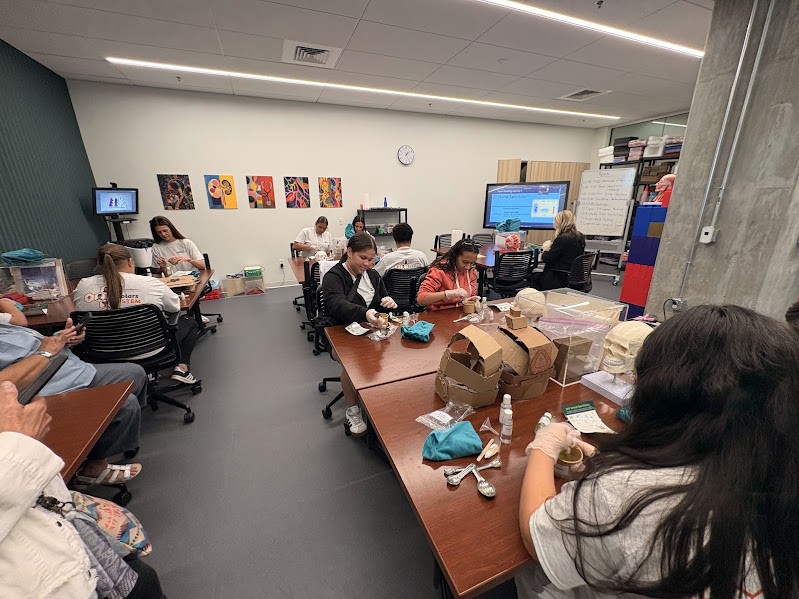
As a longtime educator and leader with the Lumbee Tribe of North Carolina, Rita Locklear knew that she wanted a hands-on, science-focused experience for the group of high schoolers she led as part of a Lumbee summer camp called Project CREATE, which is short for “Career Readiness and Educational Advancement Through Native Youth Empowerment.” Her interest in The Pearl, Charlotte’s first innovation district, grew from conversations with the district team and learning more about their commitment to healthcare education for all ages.
This summer, The Pearl was proud to host eight of Rita’s students for a visit across several parts of the district. The July 15 tour included an interactive case study at the Siemens Healthineers Experience Center, career Q&A, a tour of the Howard R. Levine Center for Education building, and hands-on activities in the K-12 STEAM (Science, Technology, Engineering, Arts and Math) Lab.
A part of the Project CREATE programming, Locklear’s camp, called “Remedies: Nature, Health & Science Camp Careers,” offers opportunities for Indigenous youth to explore future career in science, technology, engineering, arts and mathematics (STEAM). Project CREATE is a five-year grant extended to the Lumbee Tribe of North Carolina from the United States Department of Education.
The Lumbee Tribe is one of the largest tribal nations in the U.S., with deep roots in southeastern North Carolina. Engaging Lumbee youth in the immersive science, technology and healthcare innovation at The Pearl opened their eyes to career possibilities in STEAM – an industry where Native Americans have been historically underrepresented.
“The Pearl provides real-world exposure to careers that connect health, science and technology, allowing students to see how classroom concepts come alive in professional settings,” Locklear said.

The students began their day at The Pearl at the Siemens Healthineers Experience Center, where the company showcases its cutting-edge healthcare technologies, including advanced imaging and diagnostics and therapeutic solutions. The students shared about their own career aspirations, ranging from anesthesiology to law to nursing.
In a presentation to the students, Joanna Burns, head of the Experience Center, detailed the upcoming staffing shortage in the healthcare industry and emphasized the career opportunities it creates for young professionals. The world is projected to be short a staggering 11 million healthcare workers by 2030, Burns noted.
To see what a day in the life of a healthcare professional might be like, Christine Bordeaux, radiation safety officer & equipment manager, led the students through an interactive tour of the Experience Center. Bordeaux framed the tour through the perspective of a case study, asking the students to imagine that a 16-year-old patient had been in a car accident and arrived at the emergency department with multiple injuries.
Beginning with the mock ICU room, Bordeaux demonstrated the cutting-edge technology in each part of the Center. She showed the students a handheld blood testing device and an ultrasound machine capable of displaying a bedside sonogram of a blood vessel. Moving to the X-ray room, the group observed scans that showed the broken bones the imaginary teenaged patient would have experienced. The students identified the bone in question as the patient’s femur, going over the anatomy of the leg with Bordeaux. During a demo of the X-ray machine, one of the students played the role of the patient, demanding help from her fellow students acting as “nurses” – drawing laughter from the room of teenagers.

During lunch, the students had a chance to sit down with the Siemens team and ask questions about careers in healthcare, from Bordeaux’s experience as an emergency department nurse to Burns’s journey to heading up the new Experience Center. Two students from the new Wake Forest University School of Medicine campus at The Pearl joined the lunch and learn, giving the high schoolers a look behind the scenes of their journey to medical school.
Getting to hear directly from those in healthcare resonated with the students.
“Once onsite, it was evident that students could envision themselves in future careers there. Meeting professionals who shared relatable backgrounds and experiences made the visit even more meaningful,” Locklear said. “Students felt they were learning in a space that values curiosity, community and possibility.”
With their tour completed, the students explored more of The Pearl. In the Center for Education, they visited classrooms on the seventh floor, learning about the various education and career paths that could begin right where they stood, at the Wake Forest School of Medicine Charlotte or the Carolinas College of Health Sciences.
In the STEAM Lab, it was time to get hands-on. The group engaged in team building by making their own hand sanitizer, and then experimented with some of the cutting-edge tech at The Pearl. Students had a chance to design and build prosthetics and explore human anatomy using 3D simulations — the very same simulations used by medical students at The Pearl.
Before leaving, each student received a STEAM Kit to continue exploring at home. As they returned to Robeson County, each student was now equipped with a rich understanding of all the career pathways awaiting them in healthcare, and perhaps even at The Pearl.
“If we want to grow health careers that truly serve our people, we must build strong partnerships that expand what our children know is possible,” Locklear said. “When we widen their understanding, we widen their future.”
