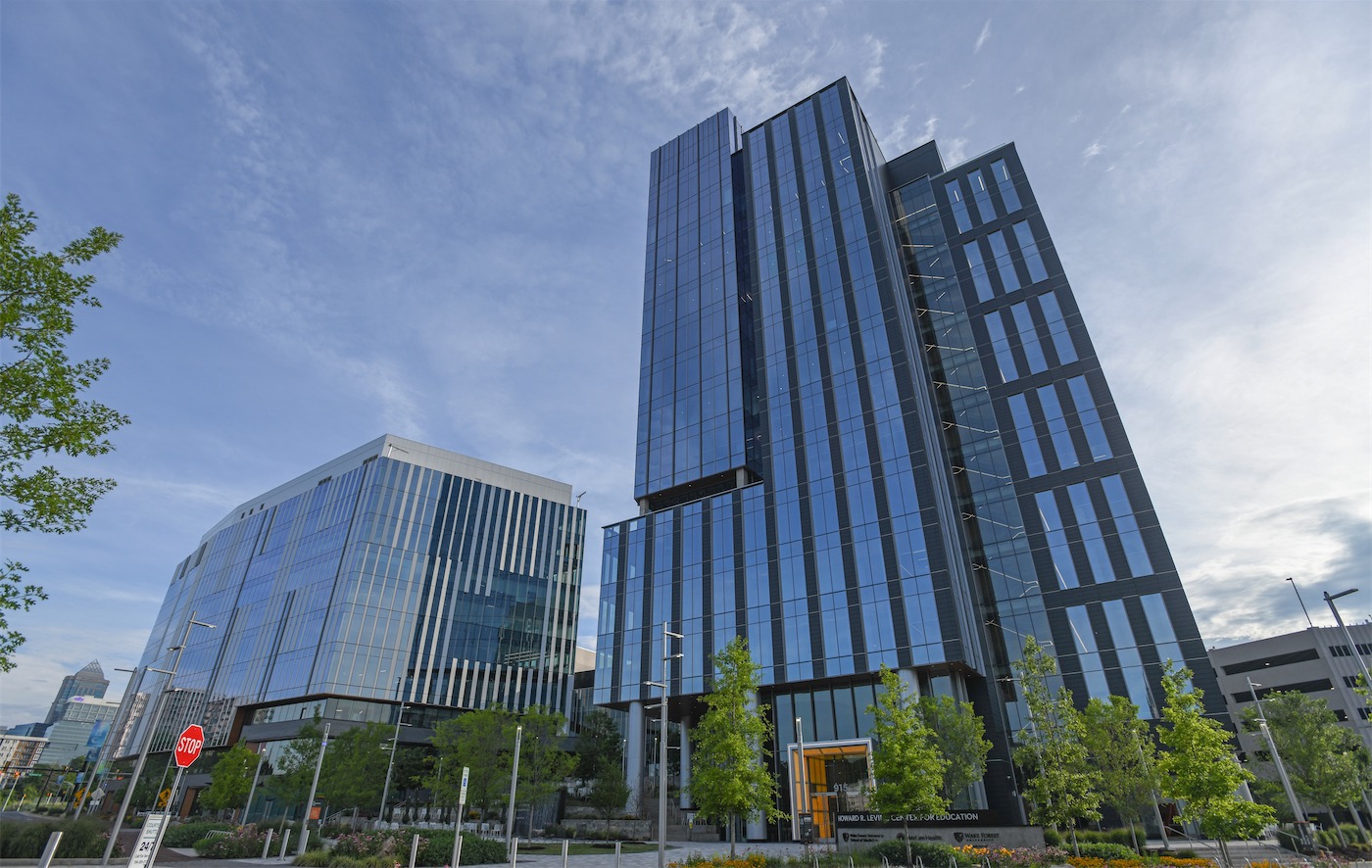
One year in, Charlotte’s first innovation district is attracting talent, anchoring life sciences growth and re-shaping the city’s economic future
The corporate names emblazoned on Charlotte’s glimmering skyline have long been a reminder that the financial sector built the city and remains one of its most powerful economic engines today.
But just outside Uptown, the names splashed across a new set of buildings at The Pearl, Charlotte’s first innovation district, tell a story of another fast-growing pillar of the local economy.
One year after opening, The Pearl has emerged as an increasingly important driver of Charlotte’s effort to diversify an economy long dominated by banking.
Building Charlotte’s Innovation Hub
The Midtown campus — created through a partnership led by Atrium Health and Wexford Science & Technology, and now home to the Wake Forest University School of Medicine, the North American headquarters of the internationally recognized surgical training institute IRCAD, and a growing mix of research, education and business tenants — is helping establish Charlotte as a hub for life sciences and healthcare innovation.
In doing so, The Pearl is beginning to attract an entirely new wave of students, researchers, clinicians and companies to Charlotte.
How Innovation Takes Hold
Economists refer to these types of intentionally collaborative place as “clusters,” says Matthew Metzgar, an economist at UNC Charlotte. Think of these somewhat like Silicon Valley, where startups converge with universities, venture capital firms and a huge field of tech talent.
These clusters help add variety to the labor force, and they introduce new industry to the region. An economy that isn’t overly reliant on one industry, Metzgar adds, is ultimately a stronger one.
“If you have some diversification in your local economy, you can protect against the ups and downs that are going to happen in the overall economy over time,” Metzgar says.
New economic impact data underscores the immediate benefit The Pearl has had.
Early Impact: By The Numbers
Only one year after it opened, The Pearl has already generated 560 permanent onsite jobs. It has had an overall economic impact of $224 million on the local and state economy when accounting for visitor spending, onsite jobs and student spending, according to a recent independent study by HR&A, a real estate and economic development advisory firm.
At the same time, The Pearl’s influx of guests generated 16,300 hotel nights and an estimated $7.4 million in total visitor spending across Charlotte’s lodging, dining, retail, and transportation sectors – a welcomed boost to dozens of local small businesses in a competitive market.
Training Future Generations
The Pearl is already cultivating a new generation of healthcare talent – a rapid feat for Charlotte, which for years was the largest U.S. city without a four-year medical school.
This past academic year, Wake Forest University’s Charlotte-based medical school educated 49 students. That figure will grow to 96 across two classes this upcoming academic year, with plans to expand to 384 students by 2032. Eventually, these medical students will do their clinical rotations at Atrium Health Carolinas Medical Center and other Atrium Health hospitals in the Greater Charlotte region, applying the medical education they received at The Pearl directly to hands-on patient care.
Also at The Pearl, Carolinas College of Health Sciences, which offers certificates through bachelor’s degrees to prepare students for healthcare careers, saw enrollment of up to 815 students last year, with each pursuing opportunities in nursing, radiology technology, surgical technology and advanced simulation support.
In focusing on such fields, CCHS graduates are filling a rapidly growing need – especially in fields like nursing – as the workforce ages and shrinks, and as Charlotte’s population continues to swell.
And beyond healthcare, talent across other fields is being nurtured within The Pearl’s walls, too.
Expanding Beyond Healthcare
This past spring, Wake Forest University opened its new Charlotte Campus in The Pearl’s Howard R. Levine Center for Education, featuring the School of Business, the School of Professional Studies and the School of Law.
In this upcoming school year, Wake Forest’s undergraduate study away and Law School externship program will begin, offering students the chance to work with and learn from local professionals – and experience all Charlotte has to offer young people.
From Vision to Momentum
Looking back, Charlotte has come a long way since Eugene A. Woods became chief executive officer of Atrium Health, which is now part of Advocate Health, a decade ago.
Woods didn’t just want to bring a medical school to the city, recalls Tracy Dodson, chief operating officer and head of economic development for the Charlotte Regional Business Alliance, the region’s main business advocacy and economic development organization: “’I can do something more,’” she says of Woods’ passion for the future innovation district.
Then later, in 2018, Amazon left Charlotte off its short list of consideration for its second headquarters – sparking a region-wide conversation about Charlotte’s talent pool and innovation economy, as well as an intentional shift in the local economic development world.
In the last several years, the city has seen a notable growth in the number of large employers and new industries planting their flag here, from fintech companies to electric vehicle makers.
These days, in selling Charlotte to prospective companies and professionals considering relocating to the city, local boosters typically focus on a handful of draws to the region: The airport, the weather, the cost of living, the proximity to esteemed universities.
But increasingly, The Pearl is proving to be a powerful economic recruitment tool. It’s becoming a topic of conversation in development circles because it’s “a story about “where we’re going,” Dodson says.
“What’s been great over the past year is now we have this whole spectrum of things to talk about,” Dodson says. “And people are typically blown away when they hear it’s all happening between the two buildings.”
A Global Magnet for Talent and Training
One significant draw of all the travelers to The Pearl has been the internationally renowned surgical training institute IRCAD, with facilities across the globe. It opened its North American headquarters at the innovation district last September. In its state-of-the-art facilities, IRCAD North America (IRCAD NA) offers hands-on courses in innovative healthcare technology to thousands of surgeons and rapid-cycle R&D opportunities for medical devices.
Dr. Dionisios Vrochides, IRCAD NA’s executive director, called IRCAD NA “the glue” that brings together a confluence of industries and clinical technicians to enable the application of training — such as remote surgery, wherein surgeons operate on patients from afar using advanced robotic systems – to real-life healthcare settings.
In less than a year, IRCAD NA has hosted 130 trainings and events, welcoming researchers, doctors, and industry leaders from at least 17 different countries. Each training averages 45 participants who stay an average of two nights in Charlotte. Sometimes, surgeons who come from overseas bring their whole families, making a larger trip out of their training, Vrochides says.
Charlotte’s already making an impression on many of these medical leaders.
“Because of IRCAD, we will enhance the offerings of medical tourism in Charlotte,” Vrochides says. “We have already started seeing that. National and international conferences that would never come to Charlotte are already coming to Charlotte because of IRCAD.”
One of many examples, he adds, is the Society of American Gastrointestinal and Endoscopic Surgeons (SAGES) conference – the biggest minimally invasive surgery conference in the world, attracting about 10,000 participants.
What Comes Next
Up until now, the SAGES conference was being hosted in cities like San Francisco, New York, Montreal and Washington. But in spring 2028, it’ll be in Charlotte’s Uptown convention center. “The reason they are coming here is the hands-on sessions and the breakaway sessions that will happen at IRCAD,” Vrochides says.
Down the line, if The Pearl can continue to grow its number of conferences and events, that’s a net positive new flow of people flocking to Charlotte’s hotels, restaurants and other businesses.
“The Pearl puts another economic engine in Charlotte,” adds Metzgar, the UNC Charlotte economist.
For further information and frequent updates about The Pearl’s progress, please visit the Progress at The Pearl web page.