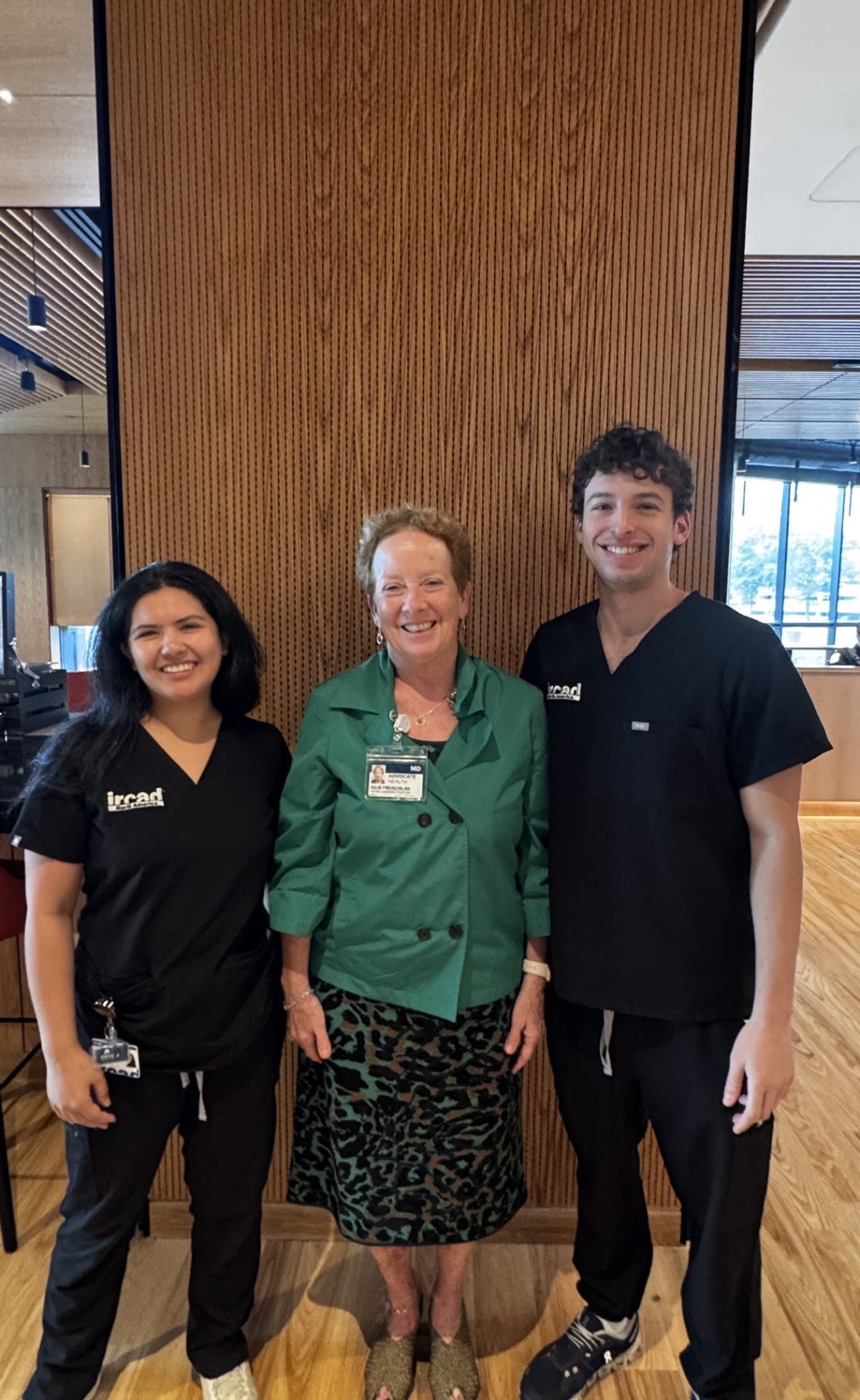
For Justin Linden, a second-year medical student at Wake Forest University School of Medicine Winston-Salem, a six-week summer internship at IRCAD North America (IRCAD NA) offered more than a behind-the-scenes look at surgery. It gave him an immersive opportunity to learn from medical experts, explore emerging surgical technology and help shape the internship program for future students.
IRCAD North America is a world-class surgical training and research center at The Pearl innovation district in Charlotte where experiential education, state-of-the-art technology and medical innovation come together. Faculty, physicians, healthcare professionals and industry partners collaborate to advance surgical training and explore new possibilities in medicine.
That environment gave Linden, IRCAD NA’s first medical student intern, a front-row seat to the intersection of learning, technology and clinical practice. Whether observing surgical training and simulated procedures, exploring medical devices or working alongside the IRCAD NA team, each day brought a new opportunity.
“Every day there was something new to learn and see, and that was the most exciting part,” Linden said.
Linden built practical skills in suturing, surgical knot tying, instrument handling, intubation, tracheostomy and airway management. He also gained experience with surgical technologies such as endoscopes, C-arms, ablation systems and humanoid robots.
While earning his undergraduate degree in history from Wake Forest University, Linden always kept a strong interest in medicine and biology. As an undergraduate, he melded these passions by writing a thesis in medicine and history, and traveling across Europe to experience the various cultures. He also spent several summers working at hospitals in Boston, where he grew up.
His path to the School of Medicine was cemented after graduating, when he spent a gap year working with Dr. Julie Freischlag as a presidential fellow at Atrium Health Wake Forest Baptist. Dr. Freischlag practiced for 38 years as a vascular surgeon and retired at the end of 2025 as CEO of Atrium Health Wake Forest Baptist, chief academic officer of Advocate Health and executive vice president of health affairs at Wake Forest University, having previously served as dean of the School of Medicine. Dr. Freischlag currently serves on the IRCAD NA Executive Board.
Linden’s work with Dr. Freischlag strengthened his growing interest in a career in medicine, and gave him early exposure to vascular surgery and a deeper appreciation for the clinical training environment at Wake Forest Baptist.
“Dr. Freischlag has been a tremendous mentor for me,” Linden says. “My interest in surgery has gone up exponentially over the past two to three years, given my experience both at IRCAD and with Dr. Freischlag.”
A highlight of the internship at IRCAD NA was observing surgeons with different specialties perform simulated surgeries, including a liver resection, an endoscopy with peroral endoscopic myotomy and a heart valve replacement.
While the technical experience was invaluable, Linden says one of the most important lessons was learning to embrace the unfamiliar. Early in the internship, many labs felt intimidating because he had limited prior experience with surgical techniques and equipment. By saying yes to new opportunities, asking questions and stepping in whenever possible, Linden says he gained confidence, strengthened his skills and discovered the value of learning through doing. He plans to carry this new mindset throughout medical school and beyond.
Outside of school, Linden welcomes new experiences by camping, backpacking and travel. He recently camped in Jackson Hole, Wyoming and is planning a trip to Yosemite National Park. Spending the summer in Charlotte was new territory, as well, but Linden found familiarity living with a fellow medical student.
Toward the end of the internship, Linden applied what he had learned to help the IRCAD NA team imagine the internship program’s future. Together, they explored ideas for a skills-based curriculum centered on experiential learning and rapid-cycle medical device research and discovery. The proposed framework includes clinical, research and non-clinical operations and innovation tracks, creating opportunities for both focused learning and interdisciplinary collaboration.
“I’d highly recommend this experience to other students,” Linden said. “It reaffirmed my interest in surgery and gave me a deeper understanding of how modern medicine brings together clinical care, technology, research and education to make an incredible impact.”